What needed solving?
An electricity bill does not tell the full story of what a solar and storage system is doing or what each dispatch decision is worth.
How I approached it
- Collected inverter and Home Assistant measurements for generation, consumption, grid import and export.
- Model time-of-use energy pricing, delivery charges, and net-metering credits separately.
- Use the model to assess savings, battery shift value, and long-run payback.
The interesting part
Separating the physical energy flows from the billing rules is essential; otherwise a dashboard can be visually convincing and financially wrong.
From energy telemetry to an accountable financial model
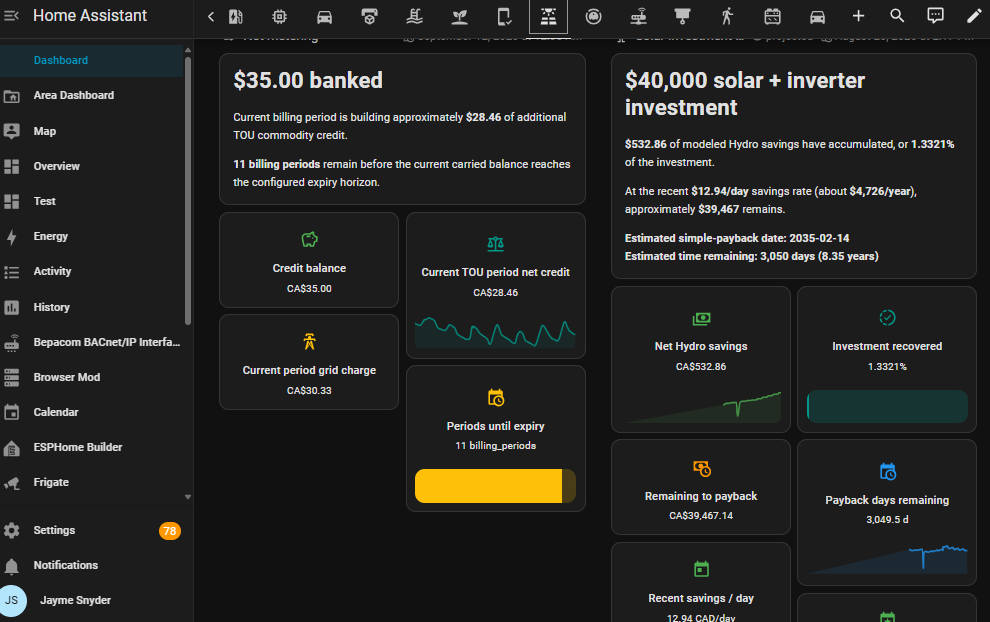
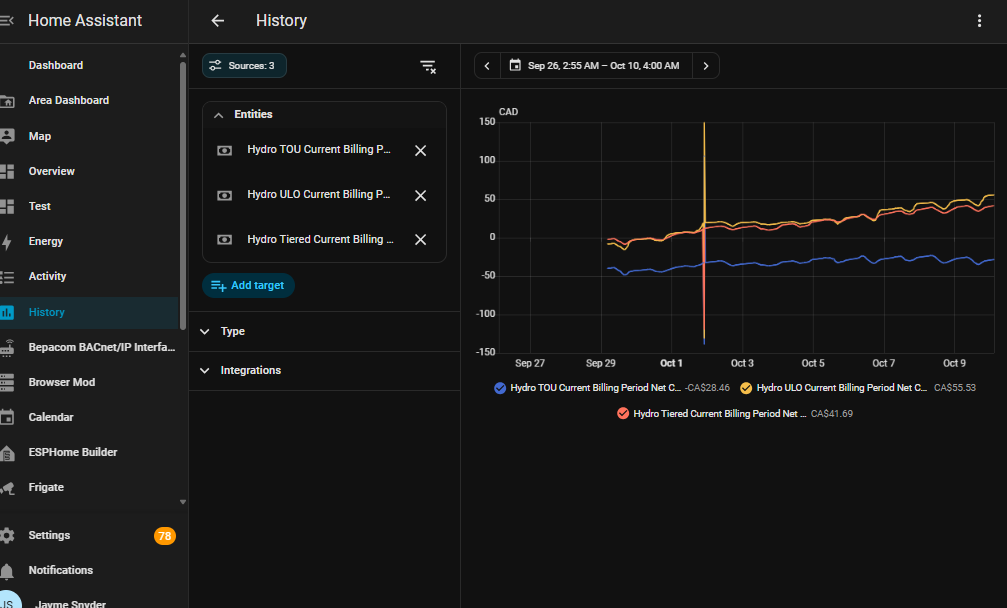
The Home Assistant screenshots below capture the running billing and payback model in October 2026. They are historical snapshots, not live financial results. The model distinguishes imported electricity, exported generation, commodity credits, delivery charges, and modeled savings. Its assumptions can be checked against utility bills.
Model boundaries matter
Imported grid electricity can incur both the energy commodity charge and applicable delivery charges; exported electricity earns a commodity credit rather than automatically reversing every charge. Banked credits, credit expiry, and billing-period timing must therefore be tracked separately from physical kilowatt-hours. A solar payback number is only as defensible as those rules and the assumptions behind its forecast.
Even with battery dispatch and generation data available, I treat an observed savings trend as a model output—not a claim that every avoided kilowatt-hour can be sold back at the retail import price. The ongoing work is validation against actual Hydro One billing and forward-looking marginal-cost calculations.
A utility bill as a reproducible model
System and data
A Solis S6 12 kW AC inverter and approximately 20 kW DC solar array are monitored through Home Assistant. The model incorporates grid imports, exports, backup loads, generation and an anticipated 16.1 kWh battery scenario.
Rate-plan comparison
TOU, Ultra-Low Overnight (ULO), and tiered billing are modeled simultaneously against the same energy measurements. Imports, delivery charges, loss factors, export credits and the treatment of carried balances are accounted for separately.
Credit expiry and settlement
A positive export balance is not equivalent to cash. The dashboard models credit carry-forward, a rolling expiry horizon and the difference between nominal energy savings and recoverable utility value.
Financial instrumentation
A $40,000 installation baseline, cumulative modeled savings, savings per day, remaining capital to recover and estimated payback date are displayed. Screenshot values are historical examples, not current readings or investment guarantees.
Battery arbitrage
Scenario calculations consider 16.1 kWh usable nominal storage, power limits, charging/discharging efficiencies and the difference between rate periods. An optimized dispatch must also preserve backup reserve and respect equipment limits.
Observations and working hypotheses are distinguished explicitly; published data is static and sanitized.